Glossary of basic concepts related to Aikido, Zen and Japan
Body parts and directions
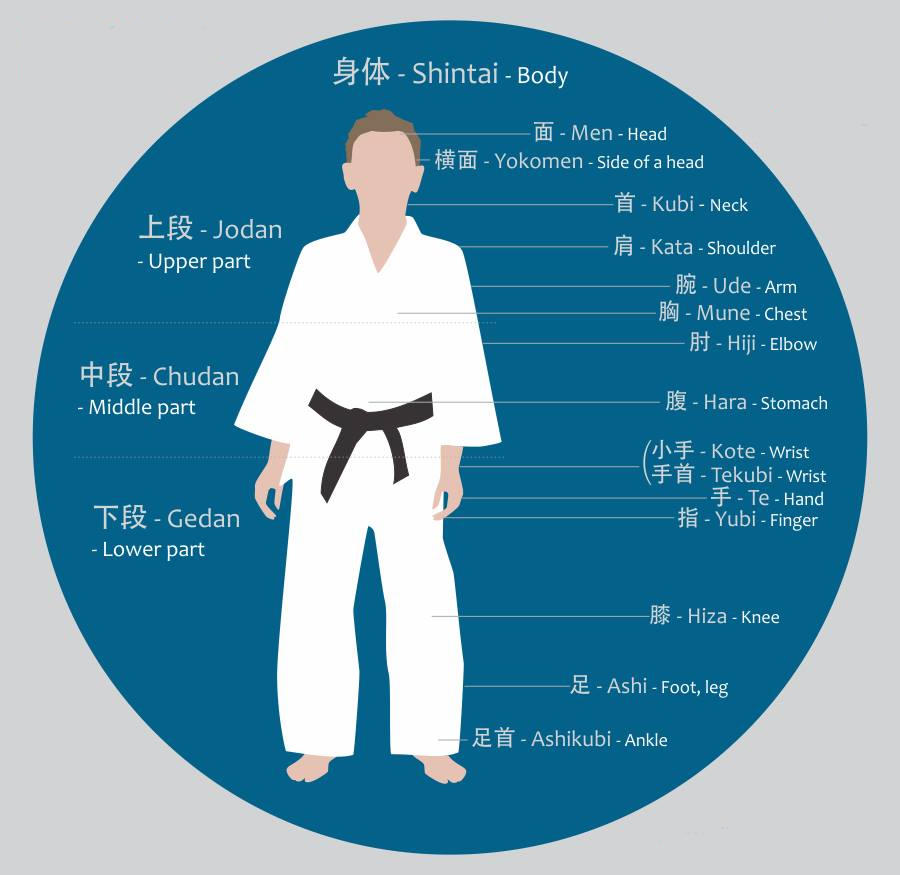
| Shintai |
body |
| Atama |
head |
| Kami |
top of the head |
| Jodan |
upper part |
| Chudan |
middle part |
| Gedan |
lower part |
| Men |
head |
| Yokomen |
side of head |
| Kubi |
neck |
| Nodo |
throat |
| Kata |
shoulder |
| Ude |
arm |
| Te |
hand |
| Mune |
chest |
| Hiji |
elbow |
| Hara |
abdomen |
| Koshi |
hips / waist |
| Mata |
thigh / groin |
| Kote (Tekubi) |
wrist |
| Yubi |
finger |
| Hiza |
knee |
| Ashi |
foot (leg) |
| Ashikubi |
ankle |
| Migi |
right |
| Hidari |
left |
| Mae |
front |
| Ushiro |
back |
| Yoko |
side |
Numbers
| rei (zero) |
zero |
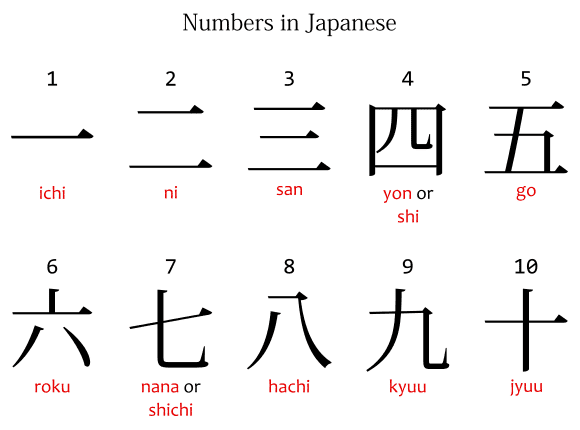
| ichi |
one |
| ni |
two |
| san |
three |
| shi |
four |
| go |
five |
| roku |
six |
| shichi |
seven |
| hachi |
eight |
| kyuu |
nine |
| jyuu |
ten |
| jyuuichi |
eleven |
| jyuuni |
twelve |
| nijyuu |
twenty |
| nijyuuichi |
twenty-one |
| hyaku |
hundred |
| sen |
thousand |
7 virtues of the warrior
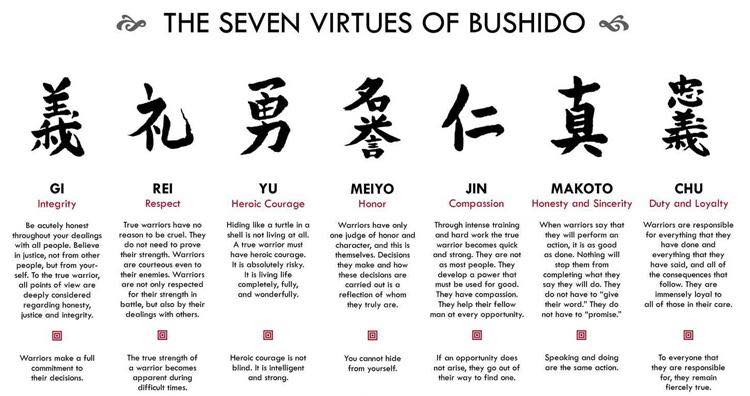
| Gi |
honesty, integrity |
| Rei |
respect |
| Yu |
courage |
| Meiyo |
honor |
| Jin |
compassion |
| Makoto |
sincerity |
| Chu |
duty (loyalty) |
Basic Aikido terms
| Aikido (合気道) |
Way of harmony with life energy |
| Ki (気) |
life energy, spirit |
| Do (道) |
way, path of life |
| Aiki (合気) |
harmony of energy |
| Budo (武道) |
martial way |
| Keiko (稽古) |
training, practice |
| Dojo (道場) |
place of practicing the Way |
| Tatami (畳) |
training mat |
| Rei (礼) |
bow, respect |
| Reishiki (礼式) |
etiquette, ceremony |
People during training
| Sensei (先生) |
teacher, instructor (lit. "born earlier") |
| Sempai (先輩) |
senior student, mentor |
| Kohai (後輩) |
junior student |
| Uke (受け) |
attacker, receiver of technique |
| Nage (Tori) (投げ) |
performer of technique |
| Shihan (師範) |
master instructor (usually 6th Dan and above) |
| Doshu (道主) |
head of Ueshiba family, world Aikido leader |
| O-Sensei (大先生) |
great teacher (Morihei Ueshiba) |
Ranks and grades
| Kyu (級) |
student grades (6th Kyu to 1st Kyu) |
| Dan (段) |
master grades (1st Dan and above) |
| Shodan (初段) |
first master grade (1st Dan) |
| Nidan (二段) |
second Dan |
| Sandan (三段) |
third Dan |
| Yondan (四段) |
fourth Dan |
| Yudansha (有段者) |
black belt holder (Dan) |
| Mudansha (無段者) |
student before black belt (Kyu) |
Uniform and equipment
| Keikogi (稽古着) |
training uniform |
| Gi (着) |
abbreviation for keikogi |
| Hakama (袴) |
traditional trousers (from 1st Kyu or 1st Dan) |
| Obi (帯) |
belt |
| Zori |
sandals used off the mat |
| Bokken (木剣) |
wooden training sword |
| Jo (杖) |
wooden staff (~128 cm) |
| Tanto (短刀) |
wooden training knife |
Stance and movements
| Kamae (構え) |
basic stance |
| Hanmi (半身) |
half stance (in split stance) |
| Migi Hanmi |
stance with right foot forward |
| Hidari Hanmi |
stance with left foot forward |
| Ai Hanmi |
same stance (both persons right or left) |
| Gyaku Hanmi |
opposite stances |
| Ma-ai (間合い) |
proper distance |
| Tai Sabaki (体捌き) |
body movement |
| Irimi (入身) |
entering into line of attack |
| Tenkan (転換) |
turn, change of direction |
| Shikko (膝行) |
walking on knees |
| Seiza (正座) |
formal sitting position (on knees) |
Technique categories
| Katame Waza (固め技) |
immobilization techniques |
| Nage Waza (投げ技) |
throwing techniques |
| Osae Waza (押さえ技) |
holding techniques |
| Kansetsu Waza (関節技) |
joint lock techniques |
| Ukemi Waza (受け身技) |
falls, breakfalling |
| Kokyu Waza (呼吸技) |
breathing techniques / Ki techniques |
Technique execution positions
| Tachi Waza (立ち技) |
standing techniques |
| Suwari Waza (座り技) |
kneeling techniques (both on knees) |
| Hanmi Handachi (半身半立) |
Nage kneels, Uke stands |
Basic immobilization techniques
| Ikkyo (一教) |
first immobilization (elbow control) |
| Nikyo (二教) |
second immobilization (inward wrist twist) |
| Sankyo (三教) |
third immobilization (outward wrist twist) |
| Yonkyo (四教) |
fourth immobilization (pressure on nerve point) |
| Gokyo (五教) |
fifth immobilization (similar to Ikkyo with wrist control) |
Basic throwing techniques
| Shiho Nage (四方投げ) |
four-direction throw |
| Irimi Nage (入身投げ) |
entering throw |
| Kote Gaeshi (小手返し) |
wrist outward turn |
| Kaiten Nage (回転投げ) |
rotational throw |
| Tenchi Nage (天地投げ) |
heaven-and-earth throw |
| Kokyu Nage (呼吸投げ) |
breath throw / Ki throw |
| Aiki Otoshi (合気落とし) |
harmony drop |
| Juji Nage (十字投げ) |
cross throw |
Types of attacks
| Shomen Uchi (正面打ち) |
straight strike to head (from above) |
| Yokomen Uchi (横面打ち) |
side strike to head |
| Tsuki (突き) |
thrust, straight punch |
| Mune Tsuki (胸突き) |
thrust to chest |
| Katate Tori (片手取り) |
one-hand wrist grab |
| Morote Tori (両手取り) |
two-hand wrist grab |
| Ryote Tori (両手取り) |
both wrists grab |
| Kata Tori (肩取り) |
shoulder grab |
| Kata Tori Men Uchi |
shoulder grab with head strike |
| Ryo Kata Tori (両肩取り) |
both shoulders grab |
| Ushiro Tekubi Tori |
rear wrists grab |
| Ushiro Ryo Kata Tori |
rear both shoulders grab |
| Ushiro Eri Tori |
rear collar grab |
Falls and ukemi
| Ukemi (受け身) |
safe fall, breakfall |
| Zempo Kaiten (前方回転) |
forward roll |
| Koho Tento (後方転倒) |
backward fall |
| Yoko Ukemi (横受け身) |
side fall |
| Mae Ukemi (前受け身) |
front fall |
Tempo and execution form
| Omote (表) |
front entry, into line of attack |
| Ura (裏) |
rear entry, behind partner |
| Ki no Nagare (気の流れ) |
flow of Ki, dynamic form |
| Awase (合わせ) |
harmonizing with attack |
Commands and phrases during training
| Onegaishimasu (お願いします) |
"Please" - start of training/exercise |
| Arigato Gozaimashita |
"Thank you" - after completing exercise |
| Hajime (始め) |
begin! |
| Yame (止め) |
stop! |
| Matte (待って) |
wait, a moment |
| Hai (はい) |
yes, I understand |
| Iie (いいえ) |
no |
| Kudasai (ください) |
please (request) |
| Dozo (どうぞ) |
please (invitation) |
| Sumimasen (すみません) |
excuse me, sorry |
Philosophy and concepts
| Masakatsu Agatsu (正勝吾勝) |
true victory is victory over oneself |
| Shugyo (修行) |
austere training, asceticism, spiritual practice |
| Mushin (無心) |
mind without thoughts, state of pure consciousness |
| Zanshin (残心) |
remaining awareness, continued attention after technique |
| Kokyu (呼吸) |
breath, coordination of breath with movement |
| Hara (腹) |
physical and spiritual center (abdomen) |
| Seika Tanden (臍下丹田) |
point below navel, center of Ki |
| Takemusu Aiki (武産合気) |
spontaneous creation of techniques |
| Misogi (禊) |
purification |
| Kototama (言霊) |
spirit of the word, sacred sounds |