Aikido / Budō
One teacher, one transmission
A student develops faster when they receive one clear direction in the moment, not several competing interpretations.
In the dojo, it is easy to confuse helping with teaching. A senior adds one comment, someone else corrects a detail, and another person shows “what works better for them.” From the outside, that can look like commitment. In practice, it often produces confusion. The student who should receive one clear direction ends up receiving several parallel versions of the same thing — and instead of understanding more, begins to understand less.
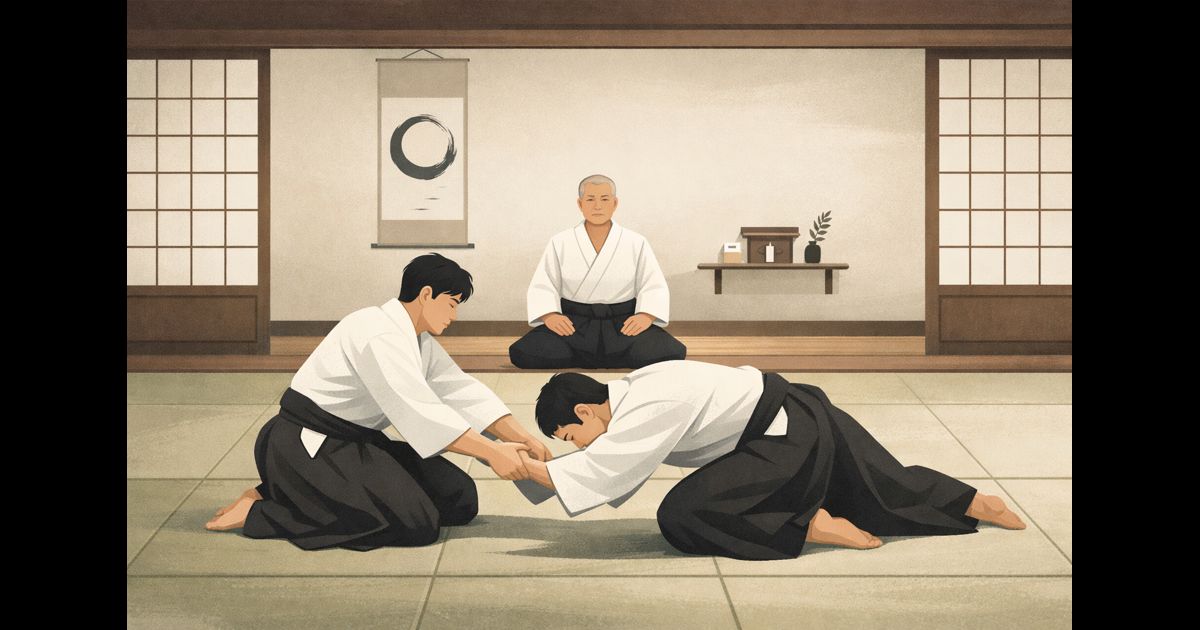
The principle is simple: when too many people start teaching at once, transmission loses order. The practitioner no longer knows what is basic form, what is a variation, what is a personal habit, and what actually belongs to the school. This does not accelerate development. It diffuses it.
Order in learning protects the student
At the beginning of practice, a person does not need many interpretations. They need form. They need a clear way of entering, organizing the body, choosing direction, using the feet, managing distance, and finding timing. They also need to know whether the technique is correct, or only “close enough.” That is why a dojo should have one main transmission. Not because others have nothing valuable to offer, but because consistency matters most in learning. Without it, even good intentions become an obstacle.
At the beginner stage, practitioners usually cannot yet distinguish a valid variation from an error, or a mature simplification from a shortcut. If they hear three different versions of the same correction, they do not become more aware. Most often, they simply begin guessing whom to trust. Guessing is not a learning method.
One teacher does not mean one person in the room
The same applies at seminars. There may be many experienced practitioners, many seniors on the mat, and many people capable of noticing something useful — but the transmission should still remain one. There is a teacher, there is a topic, there is a direction of work. Everyone else should reinforce that direction, not split it into fragments.
This matters even more when the instructor presents material differently from what someone is used to. A good seminar is not a place to filter everything immediately through old habits and convert it into “your version.” It is a place to enter honestly into someone else's way of organizing the material. If a parallel senior commentary starts beside that process, the new transmission gets drowned out before the student has really tested it.
The common problem: a senior tries to pass on their Ri to someone still in Shu
This is one of the most common sources of confusion. A senior sees technique through their own experience, through shortcuts, emphases, and solutions developed over years. That is natural. The problem begins when they try to pass that level to someone who has not yet absorbed the foundation.
In the language of Shuhari, the point is simple: you should not teach your Ri to a person who does not yet know Shu well. That student does not yet need subtle exceptions, private interpretations, or technical shortcuts. They need reliable form. If they receive “more advanced” explanations too early, they usually do not move faster toward understanding. They simply lose order.
The role of the senior student: be a good uke
That does not mean senior students matter less in the dojo. On the contrary — their role is very important. But that role does not consist mainly in constantly explaining things to juniors in a personal way. The role of the senior student is to be the best uke they can be. That too is a form of teaching — honest and aligned with the instructor's transmission.
A senior teaches through posture: through a properly organized body, an honest attack, correct distance, timing, stability, readiness, and sincere reaction. That kind of uke does not distract the student with extra theories. It gives them the right conditions to understand what the instructor is teaching at that moment. A good uke organizes learning. A bad “helper” who keeps adding personal commentary often makes it harder.
This is not easy
It is worth saying this honestly: this is not easy. A senior student's natural reflex is often to help. When they see a junior struggling with something they once struggled with themselves, they want to add something, simplify something, speed something up. They want to spare someone their own mistakes and wandering. The intention may be good. But good intention does not always produce a good result.
I once heard my Sensei tell me that I had to stop teaching during his classes. He told me plainly that explaining and teaching there was his role. Those words hit me hard at the time. They were not comfortable. But that is exactly why they stayed with me. I had to think about them seriously and remember them.
Over time I understood that it was not a ban on helping, but a lesson about order in transmission. Even a sincere desire to support someone can step into the wrong role. A senior student does not strengthen learning by adding personal interpretations while the class is being taught, but by disciplining themselves and supporting the instructor's transmission. That is harder on the ego, but fairer to the dojo and to the student.
Help is valuable only when it does not break transmission
This is not an argument for absolute silence. A senior student can help a junior student — and sometimes should. They can remind them what the teacher just showed, help them find direction, point out a safety issue, or correct an obvious mistake that blocks further work. But there is a basic difference between reinforcing the transmission and replacing the transmission.
- Good help: refers back to what the instructor just demonstrated.
- Bad help: starts with “we do it differently” or “I prefer it this way.”
- Good help: simplifies and clarifies.
- Bad help: adds another layer of interpretation.
- Good help: returns the student to the axis of the task.
- Bad help: shifts attention from the teacher to the helper's private style.
Chaos does not create independence
Sometimes people argue that many different comments “teach independent thinking.” It sounds good, but most of the time it is false. Independence does not grow out of overload by conflicting signals. It grows out of well-absorbed form that matures into understanding over time. First, a student needs something stable to hold. Only then can they begin distinguishing principle from variation consciously.
A truly independent person is not the one who collected the most opinions at once. It is the one who went through an ordered process of learning and therefore can recognize what belongs to the essence of movement and what is only someone's personal addition. Unity of transmission does not suppress thought. It creates the conditions in which thought can mature.
One transmission also requires responsibility from teachers and seniors
This rule works in both directions. If a dojo is to have one transmission, the instructor must speak clearly, and seniors must keep their ego on a short leash. Not every moment is the right place to display personal understanding. Sometimes greater maturity means holding back a comment, rather than making a sharp observation at the wrong time.
This is also a matter of loyalty to the school. A person who truly supports transmission does not compete with the teacher through constant side explanations. They help preserve the direction of work, so beginners and intermediate students do not build technique on contradictory foundations.
One transmission beyond the dojo
Off the mat, the same rule remains true. In work, craft, and teaching, beginners also develop faster when they receive a clear standard instead of five competing ways to do the same task. Only after the basics are absorbed does variety become an advantage. Before that, it is often just cognitive overload.
That is why mature environments teach order first, then understanding, and only later greater freedom. This is not limiting a person. It is an honest way of leading them through stages of development.
Most common misreadings
- “One transmission kills individuality”: no. It protects the foundation from which individuality can later grow honestly.
- “Any help is good”: no. Help that breaks the direction of learning stops being help.
- “A senior student should always explain”: no. First they should know how to strengthen training as uke and partner.
- “More comments mean faster progress”: no. Often it only means more confusion.
- “At a seminar you should compare everything immediately”: no. First you should receive the material honestly as it is.
Conclusion
One teacher and one transmission are not signs of rigidity, but conditions of meaningful learning. They give the practitioner the order needed for technique to be truly understood, instead of being patched together from borrowed comments. The senior student has an important place in that order — not as a second teacher competing with the instructor, but as a solid partner and good uke who strengthens the school's transmission instead of splitting it. Because in training, as in any serious craft, clarity must come first. Freedom comes later.