Japanese philosophy
Ensō (円相)
One stroke that reveals the quality of mind and the quality of budō.
Contents
Ensō looks like a simple circle painted with one brushstroke. In practice, it is not decoration but a record of the person in that moment: breath, tension, intention, and decision quality. In Zen, ensō is not for making a pretty image; it exposes the truth of mind state. In budō, the reading is even simpler: one movement, no excuses.
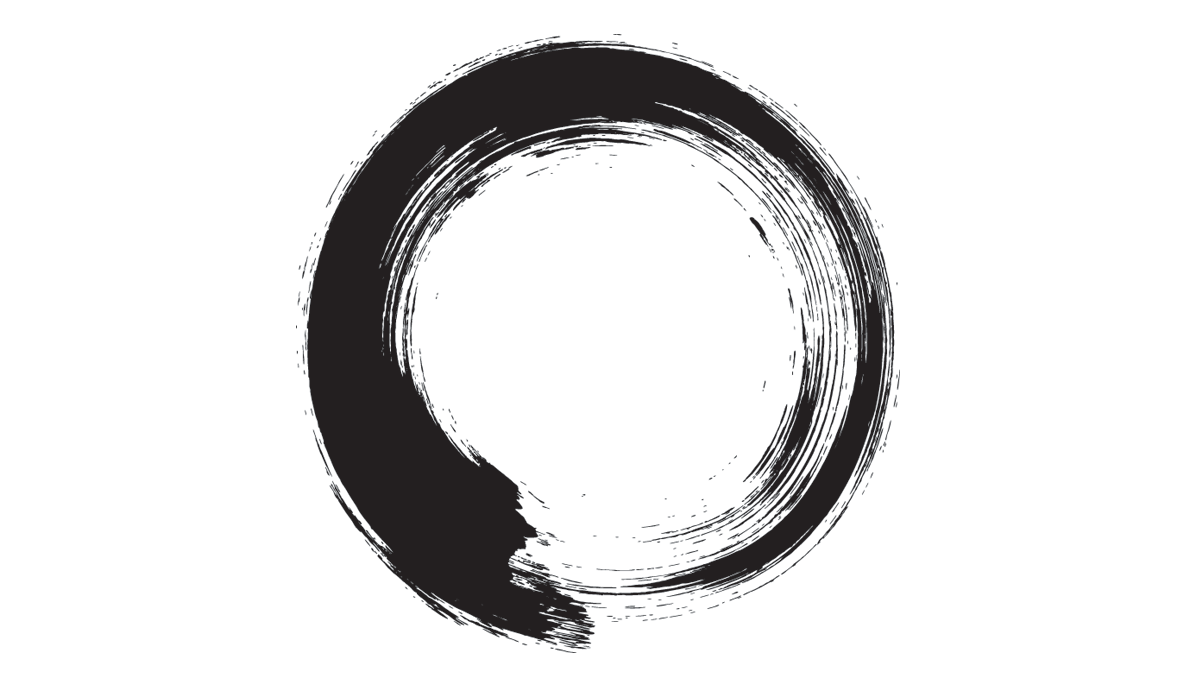
In Zen sources, ensō is often described as the “Zen circle” — pointing at emptiness and fullness, form and what goes beyond form. In many lineages it is painted after zazen, in one exhale, without taking the hand back and without correction. This form is demanding because it does not let you hide internal noise. But this is not mysticism for its own sake. It is discipline: one moment, one stroke, full responsibility.
Ensō and Zen: practical meaning
- One decision: once movement starts, do not renegotiate it halfway.
- No attachment to perfection: asymmetry is evidence of a real moment, not failure.
- Embodied awareness: the brush immediately reveals distraction.
- Unity of body and intent: the hand cannot fake center.
Some teachers distinguish an open circle (process, movement, incompletion) and a closed circle (wholeness, concentration, intentional closure). Both are useful if they return you to one question: is this action alive and true, or only visually correct?
Where are Aikido and budō in this?
In Aikido, the value of technique is not how it looks in a still image, but the quality of flow from entry to completion. Ensō is the same test. Budō does not seek “impressive” movement; it seeks coherent movement, rooted in center, timing, and relationship with the partner.
- Ma-ai (distance): as in ensō, everything begins with correct positioning before movement.
- Hyōshi (timing/rhythm): a broken rhythm instantly exposes loss of unity.
- Kokyū (breath power): if breath fragments, technique loses its axis.
- Zanshin: closure after execution is part of technique, not an extra.
This is why ensō is useful in training: less collecting of techniques, more quality in each execution. It brings practice back to the budō core: simplicity, effectiveness, responsibility.
How to train Ensō principles on the mat
- Enter without delay: decision should be calm, but immediate.
- One guiding line: keep continuity from first contact to throw/immobilization.
- No mid-action patching: do not repair movement while it is already running.
- Correct after repetition: analysis comes after action, not instead of action.
- Close cleanly: finish technique with full presence.
Ensō beyond the dojo
At work, ensō means: prepare, execute, close. In conversation: stay present instead of performing. In everyday life: less endless tweaking, more decisions made at the right moment.
Common traps
- Aesthetics over substance: beautiful shape does not replace action quality.
- Escaping into symbolism: if symbol does not improve practice, it becomes decoration.
- Perfectionism: constant correction weakens decisiveness.
- Detaching from budō: “Zen language” without body training changes nothing.
Conclusion
Ensō connects Zen and budō where both are most concrete: in the quality of one real movement. It trains presence without theatrics, decision without force, and closure without chaos. That is why this simple circle is so demanding — and so useful on the mat, at work, and in life.
Zen background source: What is an Enso? (Lion’s Roar).